How drift judging works
Drift competitions are decided by judges, not a stopwatch. Here is what judges look for in a qualifying run and a tandem battle, and how mistakes and contact are weighed.
Key takeaway
Line, angle and style earn points; mistakes are weighed by severity, location, effect and who caused them.
The short version
Judges reward controlled, committed drifting. A great run follows the course the judges have set, holds strong and steady angle, links corners with smooth transitions and stays free of mistakes. In battles, judges compare how each driver performed as both leader and chaser.
This guide explains common drift judging principles using EFVD's published Judging Guide as the reference. Every competition publishes its own rules, so always read the event's briefing.
The judged course: zones and clips
Before an event, organizers define the judged line, the path they want drivers to take, using reference points on the track:
- Outside zones: areas near the outside of a corner that the rear of the car should swing into and fill, without leaving the course.
- Inside clips (clipping points): points on the inside of a corner the front of the car should reach, without cutting the corner or over-correcting.
- Initiation point: where the car must already be drifting. Judging starts here.
- Deceleration zones: places where drivers are expected to slow, if the event posts one.
What judges score in qualifying
Qualifying runs are judged solo. In EFVD's qualifying evaluation, the categories are:
| Category | What judges look for |
|---|---|
| Line | Following the intended judged path. |
| Zones and clips | Accuracy and commitment to the reference points. |
| Angle | How much angle, and how stable and controlled it is. |
| Transitions | Timing and control when the car changes direction. |
| Flow | Momentum and how the run connects through the course. |
| Cleanliness | Avoiding spins, offs, corrections and major errors. |
A high score means a strong line, committed angle, clean transitions and few or no visible errors. A run with a spin, a stop or a major off course usually can't be scored normally.
Mistakes and how much they cost
Judges grade mistakes by how serious they are, where they happen and what effect they have on the run. Typical examples:
| Mistake | Typical impact |
|---|---|
| Small correction | Minor deduction if the run stays controlled. |
| Major correction or missed zone | Larger deduction, or a disadvantage in battle. |
| Straightening | The car loses drift angle and continuity: major deduction or DNF. |
| Two tires off course | Usually a major deduction when it affects the line or control. |
| Four tires off course | Usually a DNF. |
| Spin, stop or major off | Usually a DNF for that run. |
| Three-point initiation or stacked feints | Treated as a manipulated or incomplete initiation unless the event allows it. |
A DNF (did not finish) means the run lost so much judged value it can't count as a completed run. See EFVD's mistake severity system for the full list.
How battles are judged
A battle is two runs: each driver leads once and chases once. Judges compare the full exchange, not one isolated moment, unless that moment is decisive, like a spin or avoidable contact.
- The lead driver must drive the judged line with commitment, angle and a pace the chaser can follow, without brake-checking or changing the line to trap the chaser.
- The chase driver should stay close, copy the lead's line, angle and transitions, and avoid contact. Close proximity only earns credit when it stays controlled.
- Fault matters: a driver shouldn't be penalized for a mistake the other driver caused.
Our tandem drifting guide explains lead and chase in more detail.
Decisions and One More Time
After both runs, each judge votes for one driver or for One More Time. The driver with the majority vote wins. If there's no clear majority, or judges simply can't separate the two, they call OMT and both runs are repeated, usually in the same lead and chase order. In EFVD there's no fixed limit on OMTs; judges call as many as the battle needs.
Contact and collisions
Contact doesn't decide a battle on its own. Judges ask whether it happened before or after initiation, whether it actually changed the line, proximity, control or outcome, and who could have avoided it.
- Light, controlled contact that changes nothing may be incidental.
- Chase contact from too much closing speed is usually the chaser's fault.
- Lead contact from brake-checking, abnormal slowing or dropping into the chaser's line is usually the leader's fault.
EFVD's collision review covers nine common contact situations:
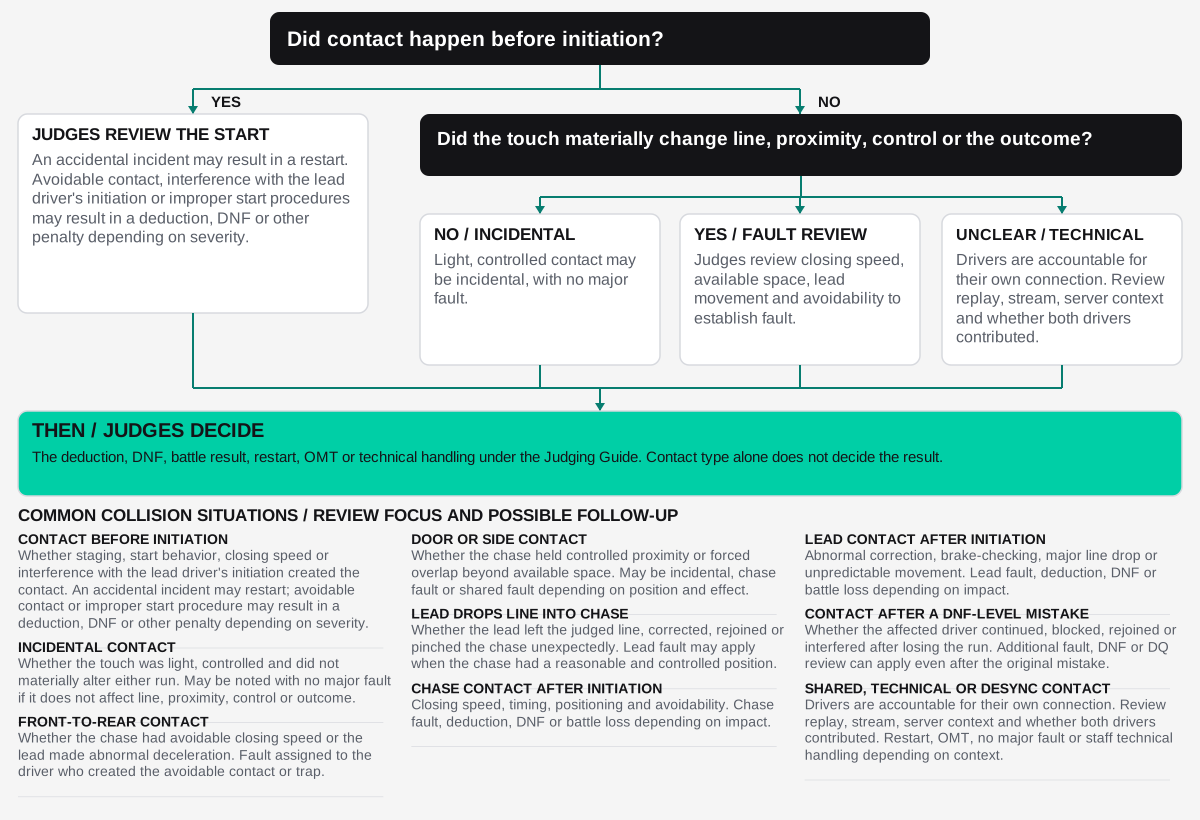
Judges and drivers can also use EFVD's one-page Judge Cheat Sheet (PDF) as a quick reference.
Why decisions are final during the event
Live events need to keep moving, so judges' calls are final in the moment and drivers can't debate them on the spot. Well-run competitions give drivers a way to ask about a decision afterwards. Judges can also review replays and telemetry tools before making a call.
Frequently asked questions
- What are the main criteria in drift judging?
- Line (following the judged path, zones and clips), angle (amount and control), and style or flow (commitment, transitions and smoothness), with deductions for mistakes.
- What is a clipping point in drifting?
- A reference point on the inside of a corner that the front of the car should reach. Outside zones are the matching areas on the outside that the rear of the car should fill.
- How do judges decide a tandem battle?
- They compare both drivers across both runs, one leading and one chasing, and vote for the stronger overall performance. A tie or split vote leads to One More Time.
- Does contact automatically lose a battle?
- No. Judges look at whether the contact changed the run and who could have avoided it. Light, controlled contact can be incidental.
- What is a DNF in drifting?
- Did not finish: a run that lost so much judged value, for example through a spin, stop or major off course, that it cannot count as a completed run.
Your next step
Compete or organize
For drivers
Compete with EFVD
Judged qualifying and tandem battles in an international Assetto Corsa drift championship.
Compete at driftcomp.com →For organizers
Organize with Event Toolkit
Judging, broadcast, registration and Discord tools built from the ones that run EFVD.
Organize at drifttournamentapp.com →